
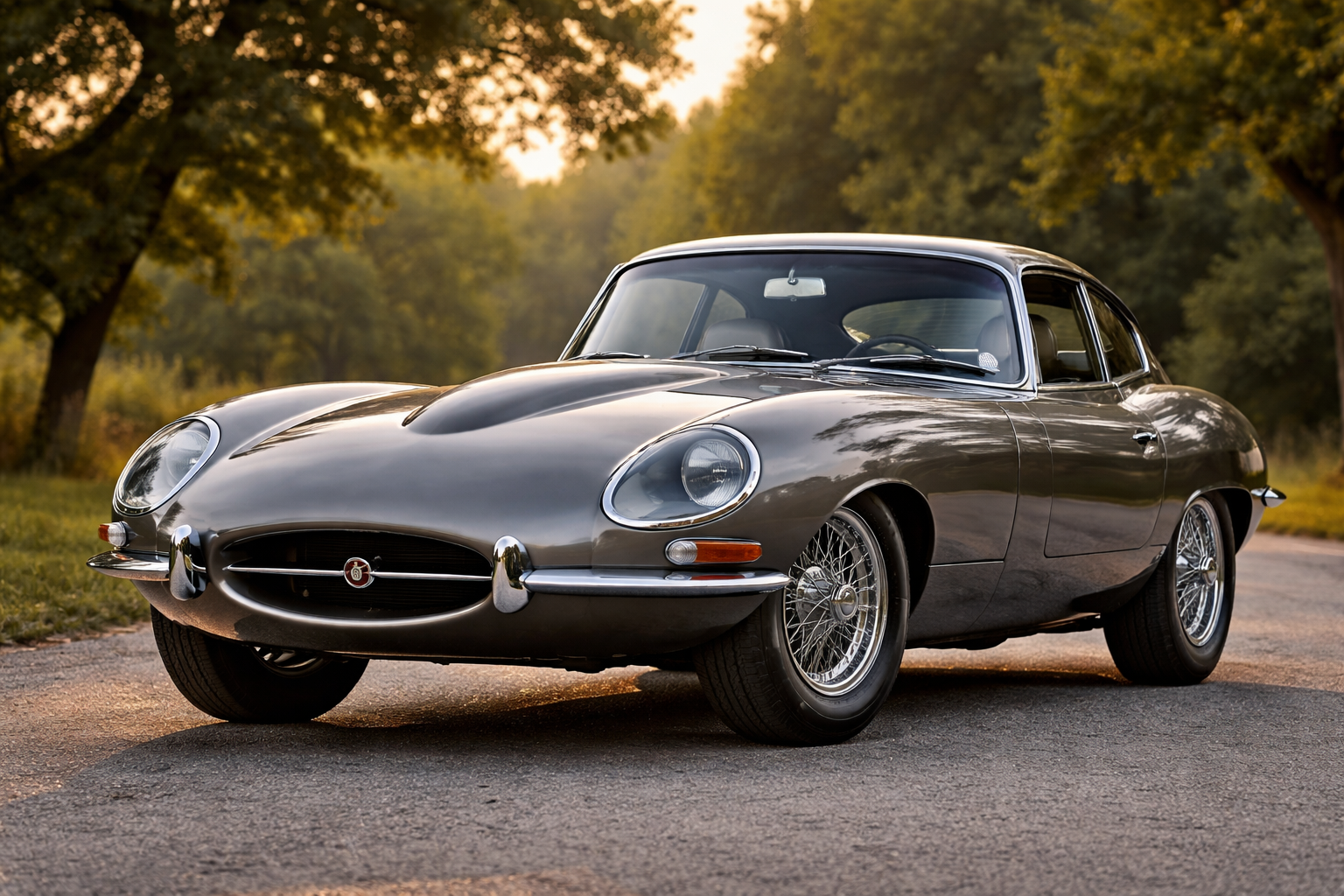
The Jaguar E-Type stands as one of automotive history’s most celebrated achievements, combining breathtaking aesthetics with genuine high performance in a package that redefined sports car expectations. Launched in 1961, this sensational machine captured imaginations worldwide with its long, sculptural hood, curvaceous bodywork, and the promise of 150 mph performance at a fraction of exotic car prices. The E-Type, with its groundbreaking design, racing-derived engineering, and cultural impact, remains the definitive British sports car and a timeless symbol of 1960s style and sophistication. Clcompany is delighted to explore the facts about this automotive masterpiece that Enzo Ferrari famously called “the most beautiful car ever made.”
Flashback
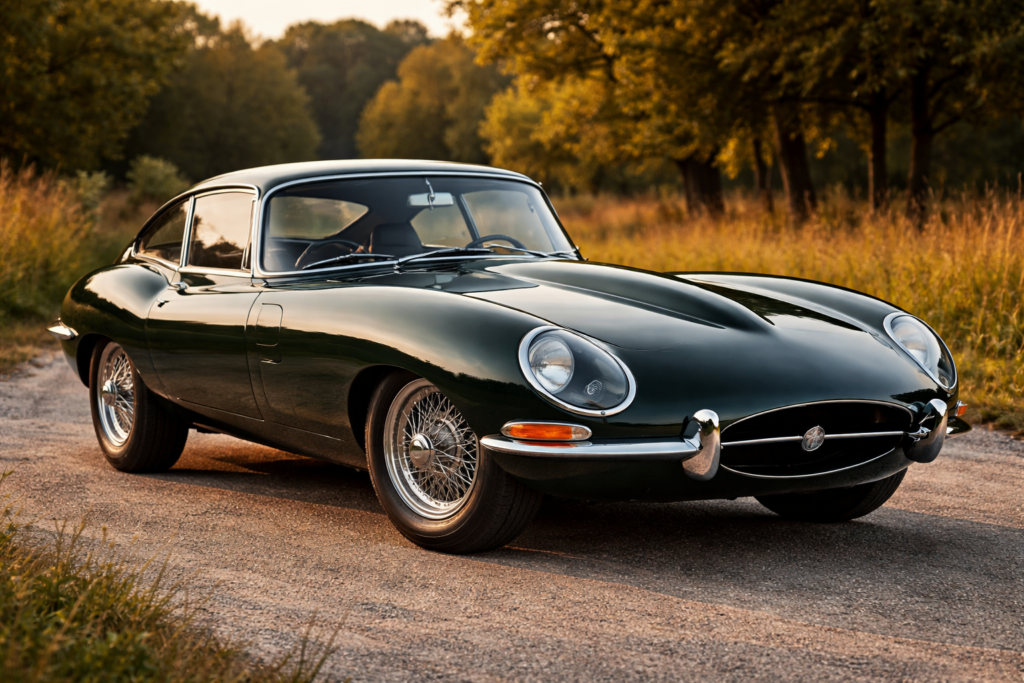
The E-Type’s story begins with Jaguar’s racing success in the 1950s. The legendary D-Type, which dominated Le Mans from 1955-1957, provided the engineering foundation for a road-going sports car that could deliver racing performance with everyday usability. Development commenced in the late 1950s under the guidance of William Heynes and aerodynamicist Malcolm Sayer, whose aircraft engineering background profoundly influenced the E-Type’s wind-cheating shape.
Jaguar unveiled the E-Type simultaneously at the Geneva Motor Show in March 1961 and in New York shortly thereafter. The reception was extraordinary—journalists and enthusiasts mobbed the Geneva stand, stunned by the car’s otherworldly beauty and specifications. Here was a vehicle capable of genuine 150 mph performance, 0-60 mph in under 7 seconds, with disc brakes on all four wheels, independent rear suspension, and a price of just £2,097 in the UK—roughly half the cost of comparable Ferraris or Aston Martins.
The E-Type was offered initially in two body styles: a sleek Fixed Head Coupe (FHC) and an elegant Open Two Seater (OTS, or roadster). Both shared the same sensational styling characterized by an impossibly long bonnet (necessary to accommodate the straight-six engine), minimal overhangs, and aerodynamic fastback profile. The design wasn’t purely aesthetic—Sayer’s wind tunnel work ensured the shape achieved remarkable aerodynamic efficiency, contributing directly to the car’s high top speed despite relatively modest power outputs.
Production continued through three distinct series from 1961 to 1975, with Series 1 (1961-1968) considered the purest expression of Sayer’s original vision. Series 2 (1968-1971) introduced safety and emissions modifications for American markets, while Series 3 (1971-1975) brought a larger V12 engine and refined styling. Over 72,000 E-Types were produced across all series, making it commercially successful in addition to critically acclaimed.
Years in production – 1961 to 1975
The Design
The E-Type’s design represented revolutionary thinking in sports car aesthetics. Malcolm Sayer approached automotive design as an aerodynamicist rather than stylist, using mathematical calculations and wind tunnel testing to create a shape that was beautiful because it was functionally optimized. The result was a form that appeared organic—flowing, sensuous, and alive—yet achieved a drag coefficient remarkably low for its era.
The proportions were dramatic: the bonnet stretched nearly two-thirds of the car’s length, creating visual drama while housing the straight-six engine positioned well back for optimal weight distribution. The faired-in headlights, covered by streamlined glass, represented advanced thinking that wouldn’t become mainstream for decades. The rear haunches swelled gracefully, housing the independent rear suspension and creating the muscular stance that became an E-Type signature.
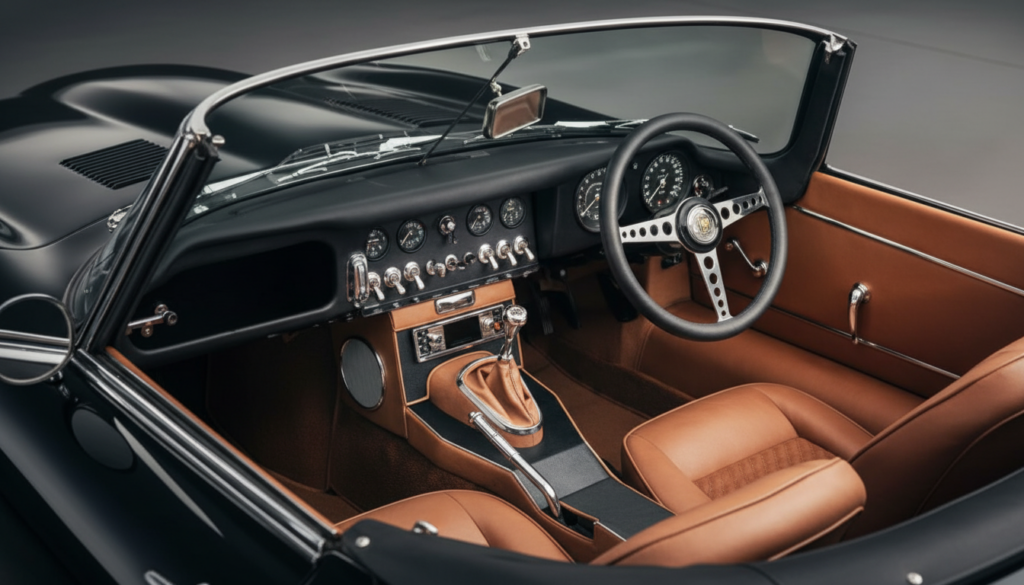
The interior combined sporting purpose with British luxury. Leather bucket seats, comprehensive Smiths instrumentation including a 160 mph speedometer and 6,000 rpm tachometer, toggle switches, and a wood-rimmed steering wheel created an ambiance of refined performance. The driving position placed occupants low and reclined, emphasizing the car’s sporting character while providing surprising comfort for long-distance touring.
Under the stunning skin, the E-Type employed sophisticated engineering. The monocoque center section provided structural rigidity, while the entire front end—bonnet, fenders, and engine bay—tilted forward as a single unit for maintenance access. The independent rear suspension, derived from D-Type racing technology, represented advanced thinking rarely seen in production sports cars. Four-wheel disc brakes, inboard at the rear to reduce unsprung weight, provided stopping power matching the performance.
The powerplant was Jaguar’s legendary XK inline-six engine, displacing 3.8 liters initially and growing to 4.2 liters in 1964. This dual-overhead-cam engine produced approximately 265 horsepower in 3.8-liter form—sufficient for genuine supercar performance. A four-speed manual transmission (later available with automatic) transmitted power to a limited-slip differential, ensuring the E-Type could exploit its considerable power effectively.
Top Specifications of Jaguar E-Type Series 1 (4.2L)
- Displacement – 4235 cc
- Power – 265 bhp @ 5400 rpm
- Torque – 383 nm @ 4000 rpm
- Transmission – 4-speed manual / 3-speed automatic
- Top speed – 241 km/h (150 mph)
- 0-60 mph – 6.9 seconds
- Wheelbase – 2438 mm
Interesting Facts
- The E-Type that debuted at the 1961 Geneva Motor Show was driven overnight from Coventry to Switzerland by Jaguar test driver Norman Dewis, arriving just hours before the unveiling. The car covered the 700+ mile journey at an average speed exceeding 100 mph on public roads—a testament to both the car’s capability and the era’s different attitudes toward speed.
- The E-Type’s cultural impact extended far beyond automotive circles. It became a symbol of 1960s style, appearing in countless films, television shows, and music videos. Notable owners included Steve McQueen, George Best, Brigitte Bardot, and Frank Sinatra—cementing its status as the ultimate celebrity sports car of its era.
- In 1966, The New York Museum of Modern Art recognized the E-Type as an objectively beautiful design, placing it in their permanent collection alongside works by Picasso and Matisse. This remains one of the few times an automobile has been formally recognized as fine art by a major museum.
- The Series 3 E-Type, introduced in 1971, received Jaguar’s magnificent 5.3-liter V12 engine originally developed for racing. This transformation addressed criticism about the Series 2’s reduced performance while creating one of the smoothest, most refined sports cars available. The V12 E-Type offered effortless 150+ mph capability with remarkable refinement.
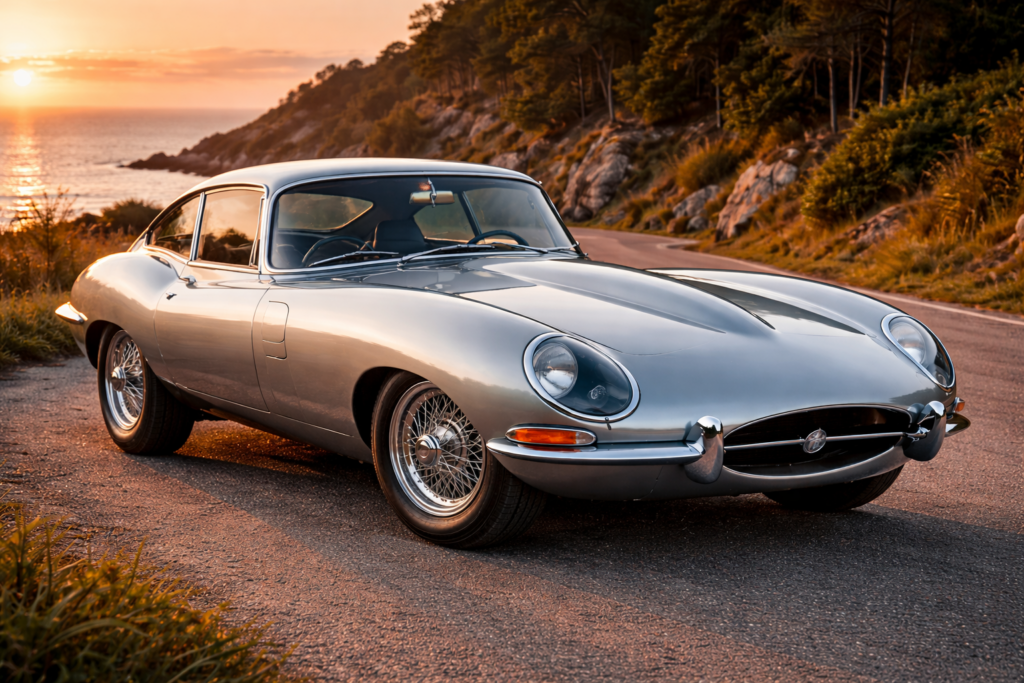
- Despite production ending in 1975, the E-Type’s influence continues. Jaguar’s modern F-Type consciously references E-Type design cues, while countless kit cars and replicas attempt to capture the original’s magic. Well-preserved Series 1 roadsters now command prices exceeding $200,000 at auction, with exceptional examples surpassing $500,000.
- An extremely rare lightweight E-Type variant was produced in tiny numbers for racing homologation. These aluminum-bodied, competition-prepared examples featured enlarged engines, racing suspensions, and minimal equipment. Today, lightweight E-Types rank among the most valuable British cars ever made, with examples selling for millions at auction.
The Legacy
The Jaguar E-Type’s significance transcends mere automotive achievement. It represents a perfect moment when beauty, performance, and value converged to create something genuinely special. The E-Type proved that exotic performance needn’t cost exotic prices, democratizing supercar ownership and forcing competitors to reconsider their value propositions.
For enthusiasts, the E-Type remains the definitive sports car of its era—the standard against which contemporaries and successors are measured. Its combination of visual drama, technical sophistication, and accessible performance created a formula that remains appealing over six decades after its debut.
Today, the E-Type enjoys unprecedented appreciation. Classic car values have elevated exceptional examples into investment-grade collectibles, while active owner communities ensure these magnificent machines continue exercising on roads worldwide. The sight of an E-Type still stops traffic, turns heads, and generates smiles—proof that truly great design is timeless.
Fascinated by automotive icons? You have reached your destination. At CLcompany we have curated pictures, write-ups, and more about the legendary journey of cars. If you are looking to share your thoughts on classic cars, do check out the writer’s section on the CLcompany website.