
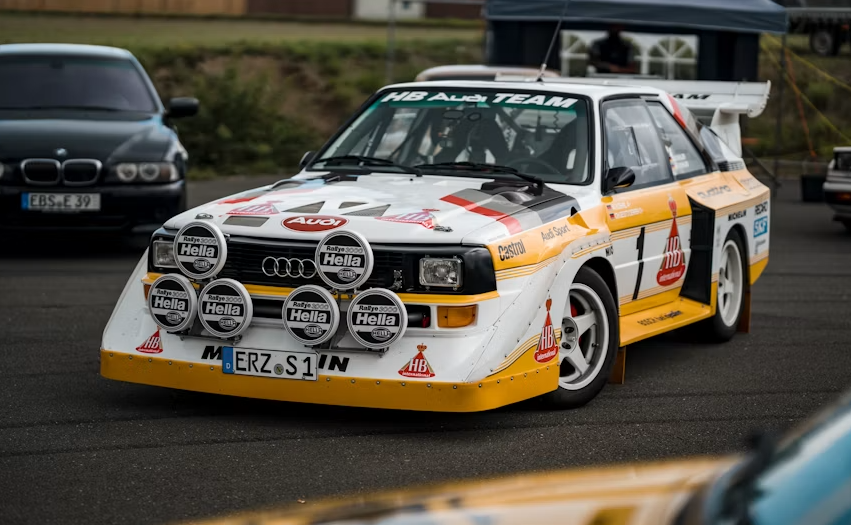
1984 Audi Sport Quattro Specifications
- Engine: 2.1-liter (2,133 cc) Turbocharged Inline-5
- Block Material: Aluminum alloy
- Valvetrain: DOHC, 4 valves per cylinder (20-valve)
- Power: 302 hp (306 PS) @ 6,700 rpm
- Torque: 258 lb-ft (350 Nm) @ 3,700 rpm
- Transmission: 5-speed manual
- Drivetrain: Permanent Quattro all-wheel drive
- 0-60 mph: 4.8 seconds
- Top Speed: 155 mph (250 km/h)
- Curb Weight: 2,866 lbs (1,300 kg)
- Wheelbase: 86.8 in (2,204 mm)
To understand the 1984 Audi Sport Quattro, we need to go back to the golden (and terrifying) days of 1980s motorsports. This is the era of the Group B rally, when rules were few, boosts were crazy, and crowds were not even a consideration. AWD was something found only on tractors and bulldozers, and there was no doubt that a heavier, more complex set of driveshafts had no place on a sporty car. Audi’s engineers strongly disagreed, and managed to change the landscape of the automotive industry forever with this particular rally weapon.
The Birth of the “Shorty”
The original Audi Quattro (the “Ur-Quattro”) was nothing ground breaking, but it did manage to prove that all-wheel drive could be competitive on a rallye course. Audi scored the manufacturers’ championship in 1982, but their opponents weren’t far behind. The other manufacturers quickly came up with their own AWD cars, and some, like the Peugeot 205 T16 and Lancia Delta S4, had purpose-built, mid-engine designs that were much lighter and more agile than Audi’s front-engine machine.
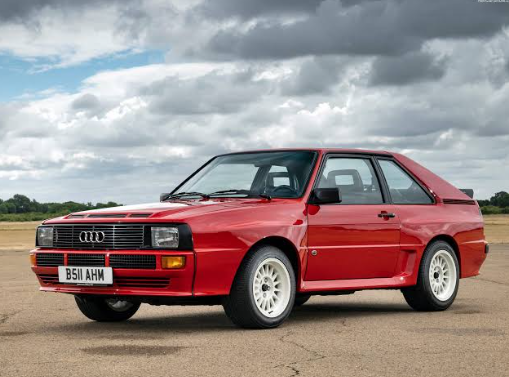
The Ur-Quattro had a very long wheelbase compared to the competition, which caused some trouble on tight turns. To fix this, Audi did something incredibly drastic: they literally shorthened the wheelbase. The new model’s wheelbase was 320 mm (12.6 in) shorter between the B and C pillars. The proportions of the car are odd, but it does give it that stubby, aggressive look. Because Group B regulations required manufacturers to produce 200 road cars for homologation, Audi prepared a “Sport Quattro” model for the public. Only 214 were produced, however, and the short wheelbase car became an extremely rare and coveted piece of machinery among car collectors.
Engineering a Group B Monster
Beneath the interesting sheet metal, the Sport Quattro was a marvel of 1980s engineering. To cut weight, Audi used some extremely advanced materials on the body panels. The fenders, roof, and apron were made of aramid fiber reinforced plastic, a composite material made of Kevlar and fiberglass. However, the real engineering magic was under the hood. Audi equipped the Sport Quattro with an all aluminum 2.1 liter 5-cylinder engine. The engine utilized a 20 valve crossflow head and a massive KKK K27 turbocharger.
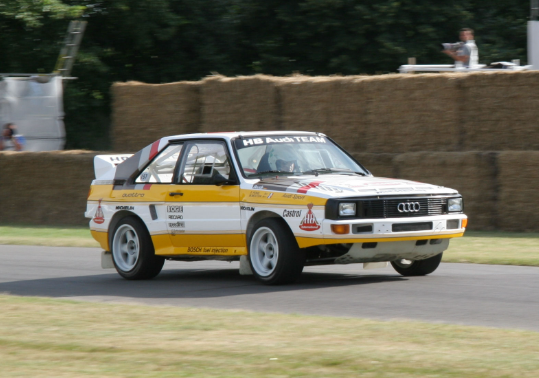
Though it was a road going vehicle, the 302 horsepower output was absolutely insane for 1984. It was leaps and bounds above the competition’s power figures, putting out more power than even a Porsche 911 Carrera of the same period. Driving the Sport quattro is an interesting experience. From 0-3500 rpm, the engine is eerily silent (the sound seems to be almost entirely generated by the turbocharger). Then, the turbo kicks in and delivers a sudden, hard hit of torque that slams you in the Recaro seats. You can hear the engine, with that characteristic “chug-chug-chug” of the five cylinder setup, as well as the audible “bleep” of the turbo’s waste gate.
Conquering the Dirt
The rallye drivers who faced the Sport Quattro’s AWD system were some of the most elite competitors of the day, including Stig Blomqvist, Michèle Mouton, and Walter Röhrl. The Sport Quattro S1 evolution model was a beast on the dirt, and it scared the crowds as it charged headfirst into the most difficult rallye courses in the world. The shortened wheel base made the car extremely twitchy, and a new driving style was necesarry to harness all of the power that the all-wheel drive system had to offer.
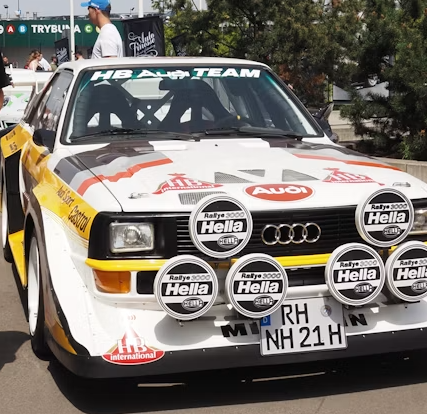
The driver had to be extremely aggressive in turning the car in, utilizing the immense power of the Quattro AWD to “hike up” the rear end of the car and rotate it through the corner. This is especially evident in Walter Röhrl’s driving style on the Pikes Peak Hill Climb, in which he slides the winged S1 up the mountainside to post the fastest time of the event in 1987.
A Legacy Cast in Aluminum
Group B was eventually banned in 1986, and Audi never participated in it again. But the Sport Quattro’s legacy was already sealed. Audi managed to prove that a front engine AWD car could be competitive in rallye racing, and the foundation was set for many of today’s high performance cars like the Nissan GT-R and the modern Audi RS models.
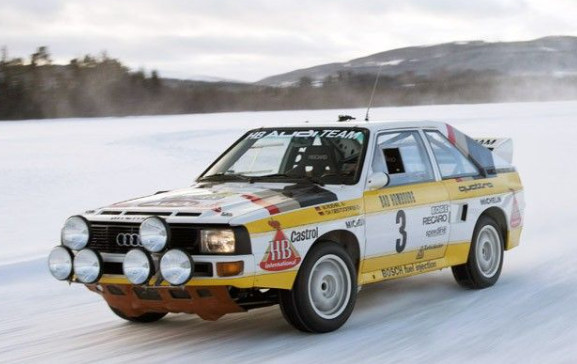
The 1984 Sport Quattro is an absolute weapon, and this stubby, flared rally car was one of the first true “wide-body” homologation specials. The Audi Sport Quattro showed the world that to improve, you often have to break the rules.
Fascinated by raw driving experiences and automotive legends? You’ve arrived at the right place. At CLcompany, we share real stories, deep dives, and reflections from behind the wheel. If you’re passionate about cars and have a story of your own to tell, don’t forget to explore the writer’s section on the CLcompany website.