

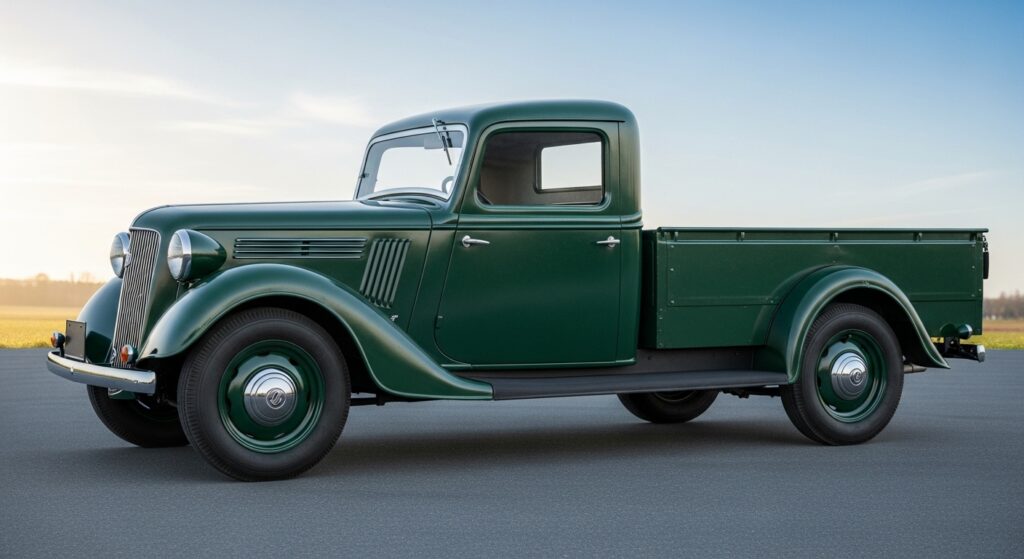
The 1935 Datsun 14 Pickup Truck holds a distinguished place in automotive history as one of the earliest commercial vehicles produced by Nissan’s predecessor company, marking Japan’s entry into the motorized transportation era. This modest yet groundbreaking pickup represented Japan’s determination to build its own automotive industry during a period when the market was dominated by American manufacturers. The Datsun 14 Pickup, with its pioneering spirit, practical design, and historical significance, remains a symbol of Japanese automotive ambition and the foundation upon which Nissan’s truck legacy was built. Clcompany is delighted to explore the facts about this 1935 milestone vehicle.
Flashback
The Datsun 14 Pickup emerged during a pivotal moment in Japanese industrial history. In 1933, Nissan Motor Company’s predecessor, DAT Motorcar Company, merged with Jitsuyo Jidosha Company, creating the foundation for what would become one of the world’s leading automakers. The company adopted the “Datsun” brand name, derived from the initials of the three original investors (Den, Aoyama, and Takeuchi) combined with “sun,” representing Japan.
The Type 14 series, introduced in 1935, marked Nissan’s first serious attempt at mass-producing commercial vehicles for the Japanese market. At this time, Ford and General Motors dominated Japan’s automotive landscape, assembling vehicles in Japanese facilities. The Japanese government, recognizing the strategic importance of a domestic automotive industry, implemented protective legislation that encouraged local manufacturers. The Datsun 14 Pickup became a symbol of this nationalistic industrial push.
Built on the chassis of the Datsun 14 sedan, the pickup variant was engineered to serve Japan’s growing need for practical, affordable transportation for small businesses, farmers, and tradespeople. This utilitarian vehicle helped establish Nissan’s reputation for building reliable, purpose-driven machines that would eventually conquer global markets.
Years in production – 1935 to 1937
The Design
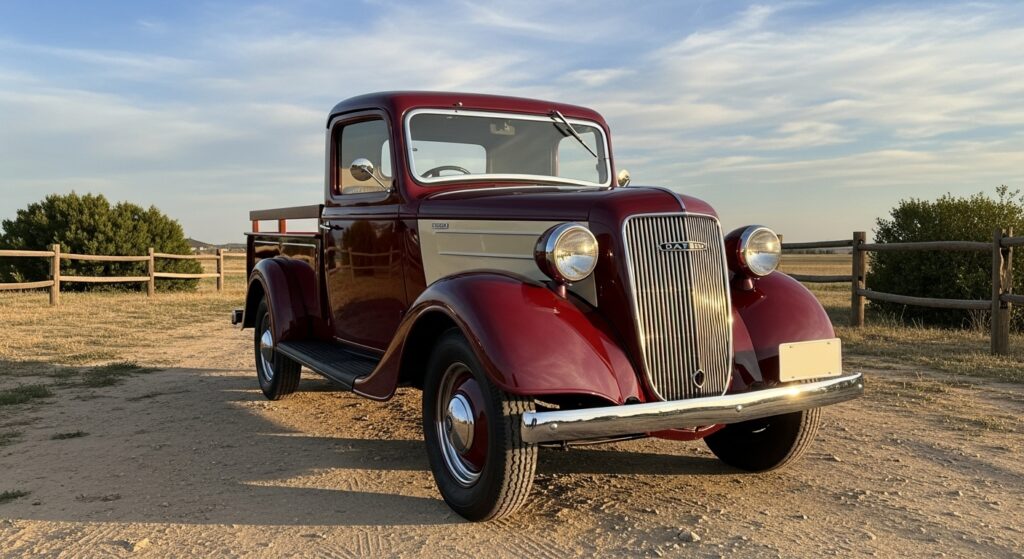
The Datsun 14 Pickup’s design reflected the practical priorities of mid-1930s commercial vehicles. Its upright, boxy styling featured a distinctive vertical grille with horizontal slats, rounded fenders, and separate headlamps mounted on either side of the radiator. The cab accommodated two passengers on a simple bench seat, while the pickup bed offered approximately 500 kg of cargo capacity – sufficient for the needs of small-scale commerce and agriculture.
The vehicle’s construction utilized a ladder-frame chassis, a robust approach that provided durability on Japan’s underdeveloped road infrastructure. The compact dimensions, measuring roughly 3.5 meters in length, made it maneuverable through narrow urban streets and rural paths alike.
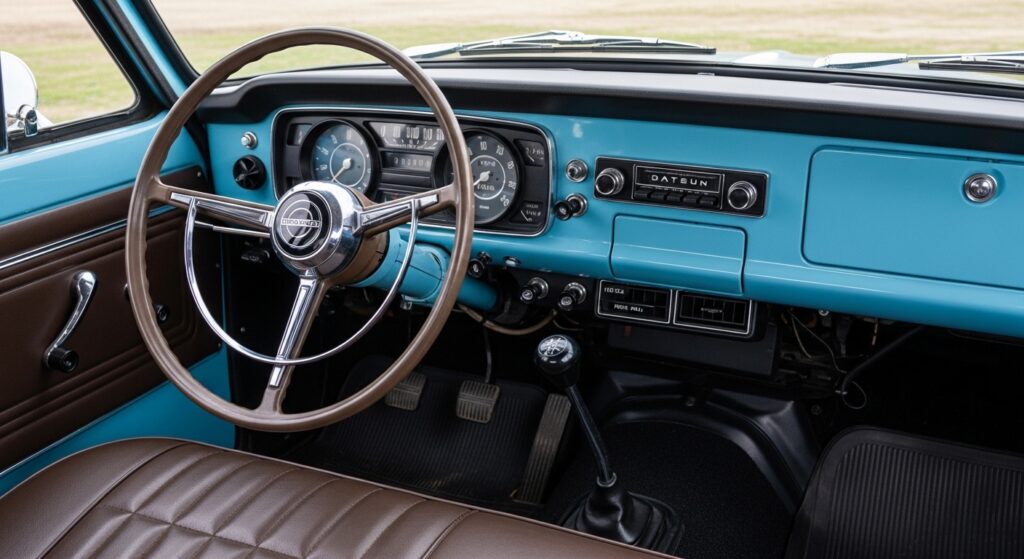
Under the hood sat a modest inline-four engine displacing just 722cc – remarkably small by today’s standards but appropriate for Japan’s taxation structure and fuel economy concerns of the era. This side-valve engine produced approximately 12 horsepower, enough to propel the lightweight truck to a top speed of around 70 km/h. Power was transmitted through a three-speed manual transmission with a floor-mounted shifter.
The suspension system employed leaf springs at both front and rear, prioritizing load-carrying capability and durability over ride comfort. Mechanical drum brakes on all four wheels provided stopping power, though drivers needed to plan their stops carefully given the modest braking performance by modern standards.
The cab interior was spartan, featuring minimal instrumentation, basic upholstery, and straightforward controls. This simplicity reduced manufacturing costs and maintenance requirements – crucial factors for commercial operators working with tight budgets. The split windshield, a common feature of the period, could be opened outward to provide ventilation in Japan’s humid summers.
Top Specifications of 1935 Datsun 14 Pickup
- Displacement – 722 cc
- Power – 12 bhp @ 3000 rpm
- Torque – Approximately 40 nm @ 1600 rpm
- Transmission – 3-speed manual
- Top speed – 70 km/h
- Payload capacity – 500 kg
- Wheelbase – 88.6 inches
Interesting Facts
- The Datsun 14 Pickup was one of the first Japanese-designed vehicles to feature a fully enclosed cab, protecting drivers from the elements – a significant advancement over earlier open-cab designs common in Japan at the time.
- Datsun’s choice of the model number “14” held special significance in Japanese culture. While Western manufacturers often avoided certain numbers, Datsun embraced “14,” which in Japanese can be read as “ichi-yon” but also sounds similar to “good” or “excellent,” lending the vehicle a positive association.
- Production numbers remained modest, with only a few thousand units manufactured during its three-year production run. This scarcity makes surviving examples extraordinarily rare and highly prized among collectors of pre-war Japanese vehicles.
- The Datsun 14 Pickup served as a testbed for manufacturing techniques and design philosophies that Nissan would refine over subsequent decades, directly influencing the development of more successful models like the post-war Datsun Truck series.
- Many Datsun 14 Pickups were pressed into military service during World War II, contributing to the already low survival rate. Those that remained in civilian hands often worked until they literally fell apart, testament to their robust construction.
The Legacy
Today, the 1935 Datsun 14 Pickup stands as an artifact of immense historical importance. While it never achieved commercial success on the scale of later Datsun vehicles, it represented Japan’s first confident steps toward automotive independence. This humble pickup truck embodied the determination and engineering ingenuity that would eventually propel Nissan to become a global automotive powerhouse.
For collectors and historians, finding an original Datsun 14 Pickup is akin to discovering automotive treasure. These vehicles rarely appear at auctions, and when they do, they command significant attention from museums and serious collectors who recognize their place in the broader narrative of Japanese industrial development. Fascinated by pre-war automotive pioneers? You have reached your destination. At CLcompany we have curated pictures, write-ups, and more about the legendary journey of cars. If you are looking to share your thoughts on classic cars, do check out the writer’s section on the CLcompany website